

If the thought of dental work while you are awake makes you want to cancel, you are not alone. For adults near Newark and Bear, Delaware, in-office general anesthesia can be a real option in a dental office, not a hospital, for treatment while completely asleep. This guide to general sedation dentistry explains what that option actually involves. We will cover what in-office general anesthesia means, where the four levels of sedation sit, and how IV sedation differs from general anesthesia. You will also learn who is eligible, what the consultation and health history review involve, how to prepare with fasting and an escort, and what to expect on treatment day, including monitored recovery on site. We will look at which dental work can be completed fully asleep, how Delaware oversees dental anesthesia, and what questions to ask an office in the Newark or Wilmington area. Suitability is decided at a consultation after a health history review, and a licensed clinician monitors you throughout. We will also explain when to call 911 instead of reading further, plus key takeaways. At Bear Glasgow Dental, home of Sleepy Tooth Sedation, the goal is to help you understand the process calmly and clearly.
What In-Office General Anesthesia Means for Adults
General anesthesia is the deepest level of anesthesia offered in a dental setting. The adult is fully asleep and does not respond to treatment. It is not the same as being relaxed but awake.
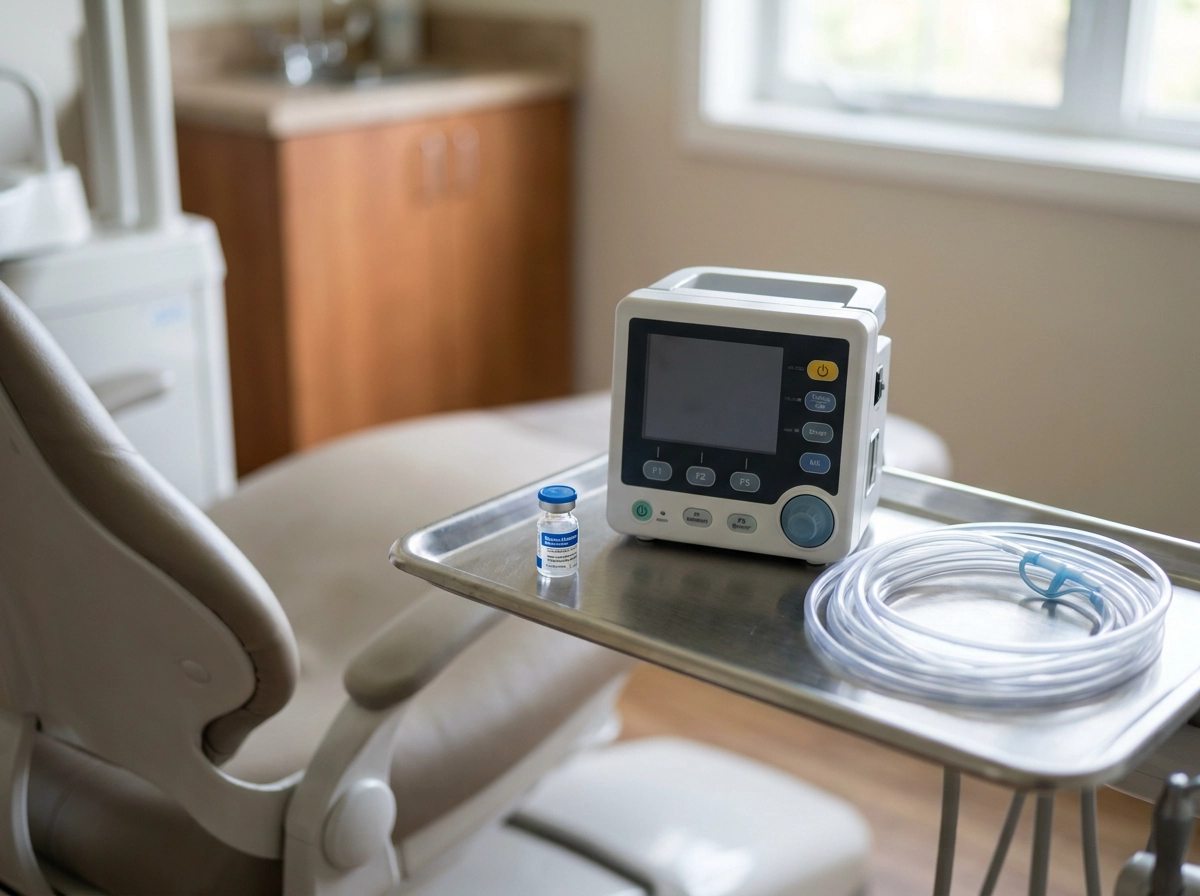
In-office means the appointment happens at a dental practice, not a hospital or a separate surgery center. Treatment, monitoring and recovery all happen under one roof.
Bear Glasgow Dental, the practice behind Sleepy Tooth Sedation, offers four levels: nitrous oxide (laughing gas), oral conscious sedation, IV sedation (sleep dentistry) and general anesthesia. Routine and complex dentistry can be completed at each level, often in fewer visits.
Delaware adults who need extensive or complex treatment, or who simply cannot tolerate being awake at all, are the people most likely to ask about this option. Suitability is not decided over the phone or from a web page. It is decided at a consultation after a full health history review, and a licensed clinician monitors you throughout treatment.
You can review the four sedation levels and choose the right sedation level for you before you ever pick up the phone.
General Sedation Dentistry: Where the Four Levels Sit
General sedation dentistry is the umbrella term for any technique that lowers awareness or anxiety during dental care, and it spans mild relaxation to full sleep. The phrase alone does not tell you how deeply you will be sedated. Bear Glasgow Dental offers four levels.
Nitrous oxide (laughing gas): inhaled through a small mask, it takes effect quickly and wears off quickly. Most people stay awake, calm and able to answer questions.
Oral conscious sedation: a pill taken before the appointment. You feel relaxed and drowsy, and memory of the visit is often reduced. An escort must drive you home.
IV sedation, sometimes called sleep dentistry: medication is delivered through a vein, so the effect can be deeper and adjusted during the visit. Many adults doze through much of the appointment and remember little of it.
General anesthesia: the deepest option offered here. The patient is fully asleep.
Which level fits you is a clinical decision, not a menu choice. Use Choose the Right Sedation Level for You to review the options, then confirm your fit at a consultation.
IV Sedation vs General Anesthesia: The Differences That Matter
Now that you know where each option sits, here is how the top two compare. Both IV sedation and general anesthesia are delivered and monitored by a licensed clinician, so the practical difference is depth, not paperwork.
With IV sedation, sometimes called sleep dentistry, you stay deeply relaxed and may drift off, but you can usually be roused and can respond to the team when needed. With general anesthesia, you are fully unconscious and unaware. That level is typically considered when treatment is lengthy or complex, or when being awake is not tolerable for you.
Preparation can differ too. Fasting windows, escort rules and recovery time are set case by case, so ask what applies to your plan.
Sedation versus general anesthesia is not a ranking of quality. The right level depends on your health history, anxiety level, gag reflex, pain tolerance and how much treatment you need, and your clinician confirms it at your consultation.
Who Is Eligible: Health History and the Consultation
Depth is only half the decision. Health history is the other half.
Eligibility starts with a full review at your consultation: medical conditions, current medications, allergies, past reactions to anesthesia or sedation, and pregnancy status. Bring a complete medication list, including supplements and anything you take occasionally. Honest answers about alcohol, cannabis and other substance use also shape your plan.
Bear Glasgow Dental serves adults and children ages 3 and older, including patients with dental anxiety or phobia, a strong gag reflex, low pain tolerance, a traumatic dental history, or several procedures to complete. Special needs patients with autism, ADHD, Alzheimer's or cerebral palsy are also served, along with nervous children.
Adults who need a large volume of work, or who cannot tolerate being awake in the chair, are the typical candidates for general anesthesia. Others may do fine with a lighter level such as nitrous oxide or oral conscious sedation.
Suitability is never decided in advance. It is confirmed at a consultation after the health history review, and a licensed clinician monitors you throughout.
How to Prepare: Fasting, Escort and Medication Disclosure
Once your consultation confirms a plan, preparation comes down to being honest and following instructions closely.
You will get a specific fasting window, and it depends on the anesthesia level and your health history. Follow the exact instructions your team gives you. Eating and Drinking Before Sedation explains the reasoning, but your own instructions take priority.
Arrange your escort in advance. An adult must drive you home and stay with you. You cannot drive yourself, and a rideshare alone is not an option after this level of anesthesia.
Disclose every medication, supplement and recreational substance, plus any recent cold or flu. These details can change the plan or postpone treatment.
Clear the rest of your day. Rest, no driving, and no important decisions or paperwork while the effects wear off.
Ask ahead about special needs during the fasting window, such as inhalers, insulin timing or routine medications, so your team can tell you what to do.
On treatment day, your escort arrives with you.
What Happens on Treatment Day
Once your prep is done, treatment day follows a steady, predictable rhythm. You arrive with your escort and go through a final health check, and the clinician confirms the plan with you before anything begins.
During treatment, a licensed clinician provides continuous oxygen and heart rate monitoring. Oxygen, reversal medications and an AED are on site, and the team drills regularly on emergency procedures. If you want to see what that monitoring looks like in practice, our guide to IV sedation safety in Delaware walks through it step by step.
Recovery happens on site in a monitored area. You stay there until the clinician confirms you are ready to leave with your escort, rather than being sent home right away.
Memory of the visit is often limited, so ask for written instructions you can read later, and have your escort listen to them too. Before you leave, confirm who to call with questions, which warning signs to watch for at home, and when your follow-up visit is scheduled.
Next, let's look at which dental work can actually be completed while you are fully asleep.
Which Dental Work Can Be Completed Fully Asleep
Once your escort takes you home, you may wonder what can actually be finished while you are fully asleep. The list is broader than most adults expect.
Cleanings and periodontal treatment: deep cleanings are hard to tolerate with a strong gag reflex or sensitive gums, and being asleep removes that hurdle.
Fillings and restorative work: from one small repair to several teeth in the same appointment.
Root canals: long chair time makes these tough to sit through awake, especially for anxious patients.
Extractions and wisdom teeth: often done under anesthesia when several teeth come out or a tooth sits in a complex position.
Implants and full mouth restoration: the work most often planned across multiple steps, and sometimes combined to reduce visits.
The final list is set after your exam and imaging. Not every case finishes in a single session, so your clinician will build a plan that fits your health and your goals. Wondering whether your own treatment qualifies? See Can I Sleep Through My Dental Work?. That breadth is also why Delaware regulates how anesthesia is delivered in dental offices.
How Delaware Oversees Dental Anesthesia
Delaware has its own rules for dental anesthesia. The Board of Dentistry and Dental Hygiene regulates it, and the Division of Professional Regulation lists permit categories including Restricted Permit I (anesthesia), Restricted Permit II and an Unrestricted Permit, though criteria are not posted there.
The rules sit in Title 24 of the Delaware Administrative Code, Chapter 1100, Section 7.0, drawing definitions from national guidelines on controlling pain and anxiety in dental patients. Delaware defines direct supervision as the dentist being present, examining the patient and checking the work before the patient leaves.
Other states differ: Massachusetts uses separate facility permits for general anesthesia and deep sedation, moderate sedation, minimal sedation and nitrous oxide alone under 234 CMR 6. That is Massachusetts law, not Delaware law.
Verify license and permit status with the Division of Professional Regulation, or ask the office which levels it may provide and who monitors you. In 2022, 1,740 active dental licenses were counted, a workforce figure, not an office count. Our guide to sedation dentistry for adults with autism, ADHD or Alzheimer's covers booking.
Questions to Ask an Office in the Newark and Wilmington Area
Regulation sets the floor, but each office fills in the rest. Ask these five questions:
Permits and monitoring. Which anesthesia levels does this office hold permits for, and who stays with you during treatment? Bear Glasgow Dental notes that a licensed clinician monitors you throughout.
Equipment on site. Bear Glasgow Dental states that monitoring includes continuous oxygen and heart rate monitoring by a licensed clinician, with reversal medications, oxygen and an AED on site and regular team drills.
Fasting, escort and recovery. What rules apply to your level, and how long will you be at the office?
Cost and coverage. What will it cost, and what does insurance cover? Bear Glasgow Dental accepts most major dental insurance and offers CareCredit financing.
Location and parking. Bear Glasgow Dental is a general dental practice at 1290 Peoples Plaza, Newark, DE 19702, serving Bear, Newark and Glasgow across Delaware, with free parking and more than 20 years of service.
Ask each one at your consultation, where suitability is decided after a health history review.
When to Call 911 Instead of This Page
Knowing what to ask is different from knowing when to stop asking and act. For any medical emergency, call 911 or go to the nearest emergency department. Do not wait on a website or a voicemail for an answer.
Warning signs that need emergency care include trouble breathing, chest pain, fainting, confusion that does not clear as expected, or a severe reaction after treatment. If you are not sure whether something is an emergency, err on the side of calling 911. Dental offices are not emergency services.
For non-urgent planning questions, call the office during business hours. Report any new medical condition or new medication before your appointment, since it may change your plan.
What to Take Away
With emergency care covered, here is the short version.
In-office general anesthesia is a real option for Delaware adults who need extensive or complex dental work or cannot tolerate being awake. It comes with concrete requirements: a full health review, fasting, an adult escort, and monitored recovery on site.
It is a different level from IV sedation, oral conscious sedation and nitrous oxide. Knowing the difference helps you ask better questions instead of guessing.
Eligibility is decided at a consultation after a health history review, never in advance, and a licensed clinician monitors you throughout treatment.
If you are near Newark, Bear or Glasgow, book a consultation at Bear Glasgow Dental. Bring your medication list and questions, and let the team say which of the four levels fits you.
Conclusion
In-office general anesthesia can be a real option for Delaware adults who need extensive or complex dental care or cannot tolerate being awake. It is distinct from IV sedation, oral conscious sedation, and nitrous oxide, and it comes with clear requirements such as a health review, fasting, and an adult escort. Eligibility is not decided before a consultation; it is determined after a health history review, and a licensed clinician monitors you throughout treatment. If you are near Newark, Bear, or Glasgow, schedule a consultation at Bear Glasgow Dental. Bring your medication list and questions, and let the team explain which level may suit your needs. Taking that step can replace uncertainty with a calmer, better-informed plan.